Thursday, April 24, 2014

Hairy vetch nodules, Experimental tillage techniques, Rabbit misconceptions

Hairy vetch nodules


young vetch plant

Last September (2013) a .24 acre field was sown to the following: oats, barley, red clover, and vetch.  The oats and barley, winter killed predictably.  The vetch and clover are coming back nicely, along with some miscellaneous grass from areas that were not cultivated well, because this area last season was planted in tomatoes, and completely mulched with old hay.

So last fall it was not totally clear what would be planted in this spot, but I knew it would be somewhat later in the following spring.  But I've just realized we need more area for both transplanted and direct sown crops in the next 4 weeks.  The greatest benefit of the cover crops would have been to let the vetch and clover get bigger, and take advantage of the symbiotic relationship between the air and nitrogen that the vetch/clover offer.


Notice below the little white nodules on the vetch roots.  The presence of these represents that certain rhizobia are present, but not necessarily the nitrogen fixing kind.  So one was dissected, and it was red/pink on the inside, from my research this indicates that the rhizobia are indeed of the nitrogen fixing kind.  Interestingly, the vetch seed was not inoculated last fall, which many sources of seed recommend doing.  This means the appropriate rhizobia were already present in our soil.

 
vetch nodules 

Experimental tillage techniques (to me at least)


So we are missing out on getting most nitrogen fixation, and biomass, but the state of the immature cover crops gave me an opportunity to try using just chisel plow and disc to prepare this ground.


Here is one chisel shank mounted on my toolbar set up, this tractor can really only pull two of these well (15hp/ shank at least needed).  The chisel plow does not turn over the ground like a mold board plow, it sort of pushes up the area on either side of the shank, and obviously fractures the soil down to depth of about a foot (in my case the tractor has a hard time pulling tow shanks buried all the way).  So two passes were made with the chisel plow shanks located on the inside and outside positions, then one last pass with one shank and the tool bar offset so I could go down the middle of the bed.  Here is what the area looked like after these 3 passes.


Now after one pass with the disc.


Much of the exposed vetch and clover is wilted down, and will probably die.  Compost and amendments will be spread, and and disced one more time, this should be ready to transplant into, but a pass with a tiller is definitely needed for any fine seeded crops.  I wish the disc could chop the debris into finer pieces.  I'm hoping all this is helping feed the microbes and make our soil better!

Rabbit misconceptions


This last month a young man who helps us out around the farm expressed an interest in keeping rabbits for meat, and I've occasionally pondered the thought, but not given any serious study to the matter.  Well he built a nice "rabbit tractor" to keep them on fresh grass and weeds, and then we proceeded to hunt some rabbits down on craigslist.  Found a great connection with a guy who has been raising them for over 40 years.  After our conversations we realize we have a lot to learn about rabbits.


white new zealand buck


brown new zealand doe

I had assumed that all the rabbits we would get would just be put in the moveable pen and everybody would be so happy.  WRONG.  We ended up getting two does from two different craigslist connections.  Upon immediate meeting they get into what appears to be a violent altercation.  I call my my main rabbit guy, "Oh yeah they will kill each other."  Ok.  Now on to what I thought was something so basic a concept, that it gave rise the the popular idiom, "to breed like rabbits."  

So first, I'm told you should bring the doe to the bucks cage, something about him getting in her space, and they fight, and she kills him.  Them I'm told that if you leave the doe in there too long after the buck has done his thing, and he tries to do it again she gets a little testy, and will castrate him!!  Wow, so far the idyllic rabbit world in my mind is coming crashing down, because it seems like rabbit women will fight and kill at the drop of a hat.

So I of course brought the buck to the doe's cage mistakenly, and sure enough the brown doe in the above picture jumped on the back of the buck and pinned him to the ground.  This confused me at first, so much so that I had to google "how do rabbits mate."

This afternoon, the doe was brought to the buck, and things are looking promising, although the buck appears to be as confused as me about mating too, he seems to have things turned around so to speak!  Not good.  At least she is not being as aggressive.  One thing to be aware of is that urine gets sprayed around pretty good. Connor said he got sprayed. ;)  Hopefully everything gets sorted out and we have baby rabbits in about 1 month.

Thanks for reading. - Blair

Tuesday, April 22, 2014

a hard day

Yesterday was a day of ebb and flow on the farm.

We woke up to find that something like half of the plants in our greenhouse were frozen.  And dead.  

The previous night, we pored over the weather forecasts .  Different sites.  Different apps.  They all said something like 38 degrees.  We know it's ever so slightly colder here, so we account for that.  We put row cover over all the plants.  We double it.  We put our heater on, under the row cover.  We check the weather once more before going to bed.  It should have been okay.  

We woke up to find that something like half of the plants in our greenhouse were frozen.  And dead.  


It's hard to explain the feelings of defeat, frustration, sadness and grief.  So much had already gone into those seedlings.  They represented into the thousands of future profits.   Some flats were mostly dead, some were mostly alive, with strong green stems and leaves.  But in the moment, you only see the death. 

Last year, a farmer friend gave us a little advice that a older farmer had given him years ago when he experienced a similar struggle..."Just keep planting."

Blair went out on the tractor and plowed up the potato fields.  I went into the house with the kids and we schooled.  Then, we all seven went out to the fields to put the potatoes in.  

We put in Purple Vikings, Kennebecs, Chieftans, Adirondack Blues, German Butterballs, and Red Pontiacs.  It was a flow to our ebb.  Just keep planting. 


Then, Blair goes back out on the tractor and I go back to the greenhouse.  I sit just outside to seed because it's still hard to face those flats.  The girls and I seed parsley, chard, scallions.  Just keep planting. 


We seed, plow, move ahead. Blair sees the first flea beetles. We notice poor germination in the spinach. The thoughts don't always come out, but sometimes they do. Sometimes they just stay in our head...

What are we doing?
There is so much out of our control.  Too many elements to battle.
I can't take this stress.
We can't do this again next year.
...starting to really hate Spring....
What else can even go wrong today?  What else.

I want to say we embraced the hardship with complete faith and level heads.  But that's just silly.  We're just being honest.  If we only showed you the painfully cute pictures of our kids in the fields and puppies and happy news, it wouldn't be fair.  This life is hard.  Mixed with bliss, yes.  But hard.

The boys transplant bunching onions.  But their rows are crooked and the spacing is off.  Blair has them pull out and start over...four inches apart, twelve inches between rows. Ebbs.  Just keep planting.


Friends come by.  Paul and Linda bring maple syrup from New Hampshire.  A kite for the kids.  We sit down and talk cows, soil, water, weeds... They are gracious and watch us eat.   It's the first time we've paused in the heavy day.  Another flow.  

Hona comes by to pick up the boys for a bit.  She says I should lay in the grass and nap in the sun for a few.  I do.  I hear the other kids playing.  Blair is back on the tractor.  Or maybe the tiller.  I lay down, take this picture, and doze...


Just a few moments later, a car pulls up.  It's the mail lady.  She hands me a pile of mail and asks if we have pigs.  We do.  "They're in the road" she says.  

What else can even go wrong today?  What else.

It was chaos.  Calling for Blair, he can't hear me.  Running for a bucket of grain to lure the pigs.  All opposite directions.  Running to the road to shoo them back into the woods toward the house.  Blair comes: we chase, we circle, we shoo, we drop grain, we holler, we corral, etc...

This is impossible.
Futile.
There are ten other things I should be doing right now. 
Is this really happening?
Whhhhhhyyyyyyyyyyyyyyyyyyy?

The guy from the rock quarry across the street comes over on his dozer.  He starts, randomly and out of nowhere, dropping buckets of gravel on our driveway and smoothing it out.  (This is the same guy that very good-heartedly decimated our front yard months ago when he excavated our front yard to allow for proper water drainage, of his own volition.  It solved the problem.  And also made our front yard look like a post A-bomb test site.  I guess he means well. :) So he goes up and down the driveway a few times and I hear crunching and crashing.  Blair and I can't hear each other over the dozer.  It's more futile than ever. We sit down and basically give up on the pigs.  I hear one of the kids say that the fence is broken.  Bulldozed. 
The fence is broken, the gate is smashed and broken.  This is where I have to smile. And just a little. It's too loony not to smile, right?  Blair is still sitting. Shaking his head.  What else?  Ebbs upon ebbs. 

Long story short(ened)...it takes all seven of us to guide the pigs down Shooting Creek Rd, back up the driveway (not through the woods, merciful God!) and they eventually run back up to the pen and through the hole they busted out of.  We breath a little. Maybe someone shouts a hooray.  Small flow.  Back to work...

Blair goes out to reseed spinach.  Hours have been lost.  He asks me to go in and clean out the greenhouse of death.  It feels like removing dead bodies.  What a sad, sad waste. It's somber and late.  I pull out all the dead among the living.  Compost the seedlings.  Consolidate cells.  Empty potting soil for reuse.  (They were just recently repotted. The soil is still good.)  Stack empty trays.  It feels like a funeral.  And I try to remove the signs of death and empty so Blair doesn't have to walk back into it again.  Ebbish flow.  

It's getting dark.  We feed the kids.  We sit for a moment and actually doze.  But there's more to be done. Evening chores.  I post a quote on facebook from a book I read last year.  It was an audiobook that I listened to while transplanting onions and weeding beets...

“‎A farm is a manipulative creature. There is no such thing as finished. Work comes in a stream and has no end. There are only the things that must be done now and things that can be done later. The threat the farm has got on you, the one that keeps you running from can until can't, is this: do it now, or some living thing will wilt or suffer or die. Its blackmail, really.”   
― Kristin Kimball, The Dirty Life: On Farming, Food, and Love

We immediately get feedback.  
You are not alone.
Thanks for your hard work.
Come to me all you who are weary and heavy laden and I will give you rest. 

And a return quote...same book, same author...

“In his view, we were already a success, because we were doing something hard and it was something that mattered to us. You don't measure things like that with words like success or failure, he said. Satisfaction comes from trying hard things and then going on to the next hard thing, regardless of the outcome. What mattered was whether or not you were moving in a direction you thought was right.” 

This is hard.  But it matters to us.  So we got up and kept going.  We are trying to do the right thing. Did the evening chores. Ran the errands.  Put the kids to bed.  And sometime around 10:30...a dinner of cold randomness and leftovers and IPAs.  We end "the day".  

I wish I had an especially clever quote or verse or thought to end with.  I only wanted to share with you the trials.  The other side of what facebook shows.  And, also, to thank you for the support you show our family.  As you can see, it means so much.  And on a day like yesterday, we truly needed it.  


~katie


Thursday, April 3, 2014

Spring warmth hastens activities

We had a load of compost delivered this morning.  This product is manufactured in our county by PME.  So far, we've been relying on compost for most of our fertility. Most composts range from a NPK of 1-1-1 to 2-2-2 (N=Nitrogen, P=Phosphorus K=Potassium).  These numbers might seem low when you are used to looking at synthetic fertilizers, but farming biologically is not as simple as looking at 3 numbers.


Compost has micronutrients and microbial activity that cannot be found in synthetic fertilizers.  Last year we applied compost at 10 tons to the acre.  This year we will be scaling back to 5 tons to the acre.  Other amendments are used based on crop requirements.  For example, Kale and Cabbage appreciate a little more Boron, and some more nitrogen in the cooler spring soils.  Organic sources of nitrogen commonly used are feather meal, or blood meal.  Potatoes will enjoy a little more potassium.  Extra sources of both potassium and phosphorus can be found in rock based powders (greensand, etc...).

One must be careful in the injudicious spreading of compost year after year though.  Higher phosphorus  levels can be manifest.  This can make certain mycorrhizal activity go dormant, and trying to use compost to meet all of a crop's nitrogen needs can disturb the balance of your soil.  Nitrogen can be accumulated by cover crops too! (clovers and other legumes, via symbiotic nitrogen fixation).

Much more on soil science to come!  We are trying to learn more every day.  We think this year is going to be a mind-opener for trying to grasp the significance of soil biology and trying to understand growing more nutritionally dense foods.  Totally expecting some kind of paradigm shift.  In future posts, we will share our experiments with the refractometer.

Today the weather was amazing, it got close to 80F here and was sunny with blue skies, but of course they are calling for some colder weather next week.  Spring in the mountains is usually a roller coaster ride for sure.  We planted somewhere around 2200+ onion plants today, the varieties were: Red Candy Apple, Candy, and Super Star.  These are all "intermediate."  Onions are sensitive to day length so it's important to raise varieties that are adapted to your latitude.


In addition to onion planting, I spent some time using the tractor to chisel plow some areas.  (More about the alternative tillage techniques I've been experimenting with later.)  Trying to avoid using a tiller when not necessary.  Mainly using a disc and a tool bar set up with two chisel plow shanks (all our tractor can most likely pull.)  Field cultivators can be added and subtracted from the tool bar quite easily.


This was an area that had gone to heavy weeds and other grasses by the end of last summer, and the chisel plows were pulling up pretty big clods.  When used in clearer areas it more or less sailed through the soil in 2 Low mid RPM range, sunk to a depth of about 8 inches. The area chiseled for the potatoes looks much nicer.

Speaking of which, we should have our potato seed here soon.  It would have been here by now, but transport out of Maine has been tricky lately it seems, due to weather. 

What tomorrow is looking like: compost spreading.
In the not too distant future: seeding spinach, carrots, beets, turnips, lettuce mix.

- Blair

Tuesday, March 25, 2014

Community Supported Agriculture (CSA)

The CSA model is relatively new in the United States, the concept having been brought to North America from Europe by Jan Vander Truin in the early 1980's.   Here is a succinct definition from USDA Alternative Farming Systems Information Center:
Community Supported Agriculture consists of a community of individuals who pledge support to a farm operation so that the farmland becomes, either legally or spiritually, the community's farm, with the growers and consumers providing mutual support and sharing the risks and benefits of food production. Typically, members or "share-holders" of the farm or garden pledge in advance to cover the anticipated costs of the farm operation and farmer's salary. In return, they receive shares in the farm's bounty throughout the growing season, as well as satisfaction gained from reconnecting to the land and participating directly in food production. Members also share in the risks of farming, including poor harvests due to unfavorable weather or pests. By direct sales to community members, who have provided the farmer with working capital in advance, growers receive better prices for their crops, gain some financial security, and are relieved of much of the burden of marketing.

Share from our farm July 3, 2013
We had a really great experience interacting with our members last year.  It feels pretty incredible to be able to provide fresh produce for our friends/families in the community.  In addition to that honor, the CSA member fees allow us to purchase the seeds, supplies and equipment we need to get the season started, and determine our family budget for the year.  

 Share from our farm October 11, 2013

We realize the model is not for everyone, but here are some great reasons why it might be for you:
  • You put eating locally and seasonally, and supporting local farms high on your priority list
  • You cherish the thought of knowing your produce has traveled less than 50 miles and was most likely harvested just that day
  • You want to know that no dangerous chemicals or genetically modified organisms (GMOs) are involved in the growing of your produce
  • You enjoy trying new vegetables and recipes throughout the growing season
Turnips and beets, washed and ready for the CSA bags...

Sunday, March 23, 2014

Cover crops and other early spring developments

The importance of using cover crops in a farming system probably cannot be overstated.  It's been practiced in some form since ancient times.

One could say that it should be an integral part to any natural or biological farmers system.  We are just really venturing into experimenting with different types of sowings and seeing what works.   I've found the book "Managing Cover Crops for Profitability" online edition to be a helpful starting place.  Sometimes you will see the term ''green manures" used in this context.  Here is some more information about using cover crops.

Here are some of the reasons you will often see cover crops being extolled:
  • Reduce erosion from wind and water 
  • Increase soil organic matter content 
  • Capture and recycle or redistribute nutrients in the soil profile 
  • Promote biological nitrogen fixation
  • Increase biodiversity 
  • Weed suppression 
  • Provide supplemental forage 
  • Soil moisture management
  • Minimize and reduce soil compaction
Some drawbacks include taking land out of production for growing of a non cash crop, and for a small market gardener perhaps not having the tools on hand to deal with matters relating to all the green matter and how to turn it under or mow it down, etc..  Having a medium sized tractor (40-50 hp) one can do quite a lot.  Or with horses.

On 3/30/13 I seeded oats and sweet yellow clover on a section of our field not really anticipating on keeping that area "fallow" for the year.  But, it ended up that way, seemed like a good experiment.

The picture below is what it looks like today.  Old oat and weed stubble, with little tufts of clover starting to grow again. Sweet yellow clover is a biennial, and in our region oats are winter killed.  So this year the clover will flower, I'll try to mow it while it's in bud stage, or right before flowering stage.


Sweet Yellow clover coming up through last years oat/weed debris

Below you can see what the sweet yellow clover looked like September of last year (2013).  I had to mow this area two times.  Once was to clip the oats down. The second time was toward the end of August to clip all the weeds.  I just drove over with the bush hog set about 1.5 - 2 feet off the ground as to not disturb the clover too much.


Above: First year growth of sweet yellow clover.


Above: Here you can see the clover amidst last years oat stubble along with the stems from the previous years clover growth.


Here we have oats, barley, crimson clover and vetch sown beginning of September 2013.  This area had tomatoes that got late blight last year.  I bush hogged the tomato plants down,  disced twice, then broadcast the seed by hand and disced in. The oats and barley winter killed leaving a light residue on the surface.  If I wanted to plant here sooner than later I could probably disc and it would be fine.  I want to wait on some areas though to see how full the clover and vetch growth gets.


Above: Oats, Barley, crimson clover, vetch


Above: Vetch coming up through winter killed oat and barley debris

For this years fallow/cover crop experiment I have the following.  .42 acre that on March 21 was sown to Barley (rate: 40#/acre), Oats (25#/acre), S.Yellow Clover (5#/acre), Crimson Clover (5#/acre), White Clover (5#/acre), Winter Peas (12#/acre, inoculated).  Here is the field, picture taken today.  Last year this the bottom half of this field had Sorghum Sudan grass, the upper did not.  I'm interested to see if this changes anything.  Cost to seed this area was $61.77.  All cover crop seed purchased through Seven Springs Farm.  Broadcast by hand, then lightly disc in.  


Sorghum/Sudan Grass being mowed last summer.  Huge amount of bio mass.

Garlic coming up nicely!  38.9#'s were planted November 11 last year.  Mulched sometime in February.  All our varieties are hard neck, most seed saved from the previous year.  (Georgian Crystal, Georgian Fire,  and a Floyd variety called Appalachian Red from Mark Schonbeck).  10 extra pounds was purchased of regional variety.


Above: Garlic mulched with old hay

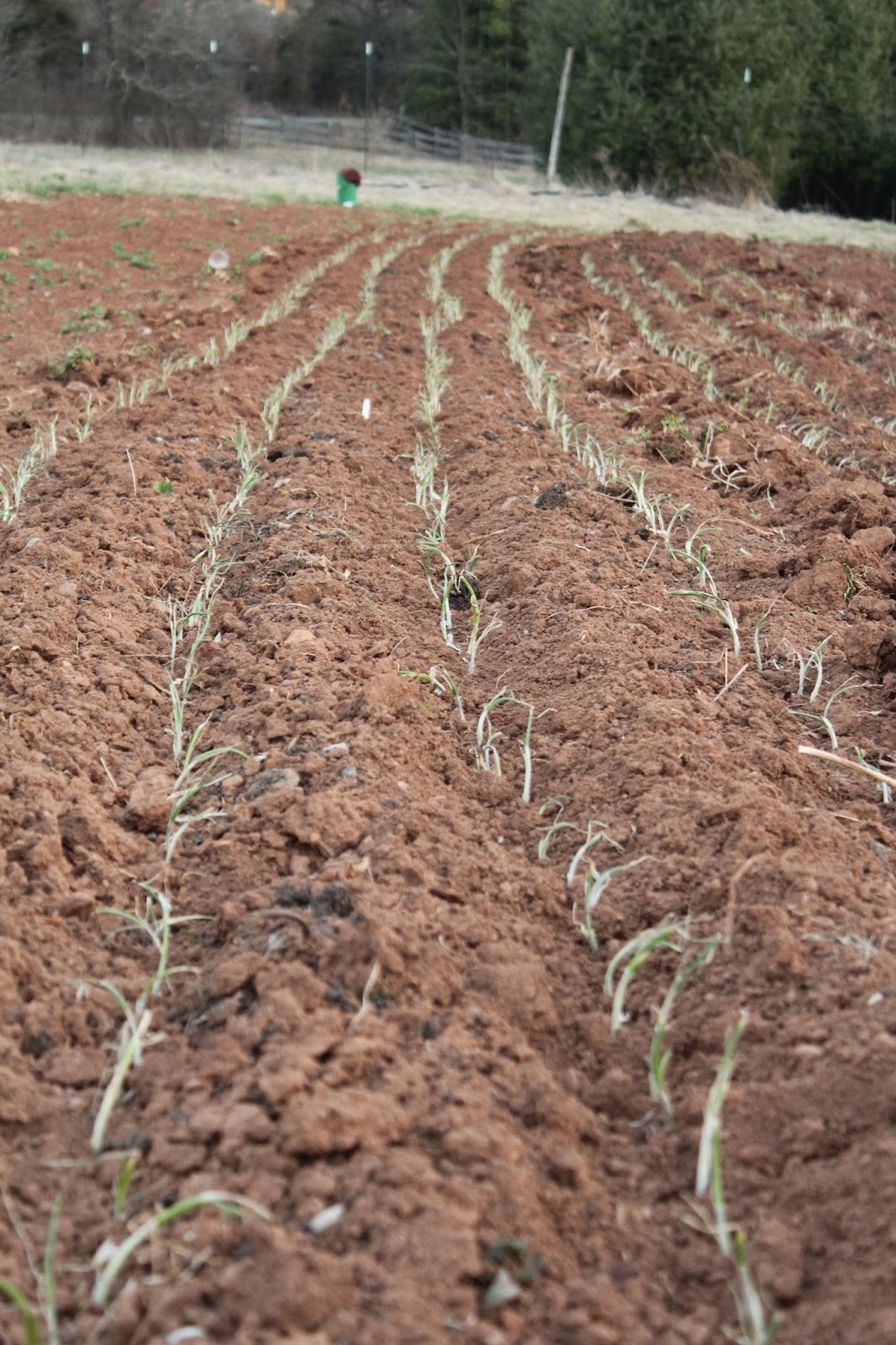
Around here, first or second week of April seems like a good time to plant potatoes.  This area was planted to oats, barley and clover last fall.  The clover didn't really add any mass or any benefit at all in this particular instance since I've just had to disc it all in to prepare for potatoes.  The winter killed oats and barley gave some protection.  I thought there should of been more plant density though.  I planted both of them at the rate of 45#/acre.  Maybe this should be increased?


Above: 2014 Potato Field

- Blair

Welcome to our farm blog!!

Last year (2013) we started our business, Black Sheep Family Farm, in Floyd, Virginia.   We both grew up in South Florida, and in 2006, with three babies under the age of three, we sold everything we had, moved into a 1989 Vanagon, and set out to find out how good food grows. We loved food. We appreciated good food. And as we started our own little family, we really wanted to raise our kids in a simpler way, in a simpler place, and just learn how to be more self-sufficient. We moved around for a few years to organic farms in Maryland, Asheville, NC, East Tennessee, and finally here in Floyd, VA.
And here is where the roots went down. We love it here. We’re so blessed to be in this place and to be able to work this land. Growing food is what we love, and it is absolutely the way we want to be raising our (now 5) kids.  We have the unique blessing of a tight community and some incredible friends and neighbors that have supported us, encouraged us, trusted us, and even shoveled compost and pulled weeds with us.

We keep sheep, chickens and pigs, in addition to raising vegetables and while it is SO far from simple, it is the simple life we were looking for.  And while our journey has been filled with hardships and many "What have we done's", we are grateful and know that our family is just so blessed.  We are exactly where we want to be, and doing what we love best.

Our farm is on 5 acres that was previously certified organic.  We are currently Certified Naturally Grown and and practice biological techniques and grow using organic standards.  We offer our produce through a CSA (Community Supported Agriculture), wholesale, and on-farm sales (contact us anytime).


We are thrilled to welcome back last year's CSA members, and still have room for some more!